| |
The first
step will be for you to contact me; we’ll have a conversation
on the phone about what it is that you want (often times that’s
as far as it goes. Most people just don’t understand the cost
involved in creating a custom piece of furniture). Once we realize
that we’re both on the same page and your project is within
my scope of expertise, I’ll come over to your place. I need
to see how you live and what your style is like. We’ll talk
about what your wants and needs are, what type of wood would work
best and the joinery to be used, and I’ll give you some good
suggestions. I may even do some basic sketches just to help you to
understand my vision. I’ll take measurements and go home to
work up a better detailed sketch. There is a design fee for this
first meeting.
This
fee can range anywhere from $250- $500 and is non-refundable.
What is this fee for?
It’s for the time I’m spending with you,
| the
time I spend at home thinking about what
you want, and
the designing of your piece. I’ll email you
what I’m thinking and we can hone in the design together
through email. There are times when a client thinks he wants
something, and when I draw exactly what he described to me
he changes his mind.( Keep in mind that these drawings may
not be to exact scale; they are more about getting you to understand
what the piece will look like).Then I have to go back to the
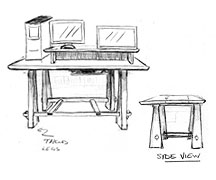
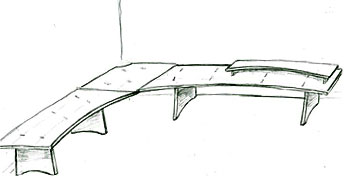
drawing board. Here is an example of what we may go through. |
|

|
|
|
You can see by looking at these drawings that the ideas for this
desk configuration changed quite a bit before I came up with what
made the client happy.
Once we agree on a design I then have to work up a bid for the piece. This
involves a working drawing with approximate dimensions so I can figure out
how much material I’ll need. I also have
to figure in expendables such as sandpaper, finishing supplies,
blade wear, hardware and
|
such.
I’ll factor all this
together and give you an estimate. This
is another reason why the design fee is non-refundable. There
are times, though not often, when a client just isn’t
ready to invest the money it will cost to craft the piece
I’ve designed for them. The fact remains that I still
did all the work.
The
next step is for you to give me a check so I can get started.
I’ll usually ask for two thirds of the total bid. I’ll
keep you in the loop all through the project. For instance,
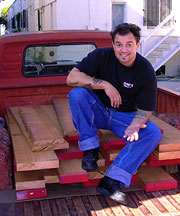
here is a picture of me with the material I purchased for
the desk in the previous drawings. |
As
the project moves along in the shop I may run into questions
for you, or there may be concerns I know you have. For instance
on this project the client wasn’t sure how my design
for a pivoting end would really work out, so as soon as I
had that part completed I sent a picture.
There are times while working with wood when things don’t go exactly
as planed. For instance, there may be a large piece of wood
that has a small defect, or I may come
up with a better idea of how to do something |

|
|
that
wasn’t apparent
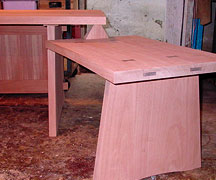
when I did the drawing. For instance, on this piece I came
up with a better way to lay out the butterfly mortises.
When these situations arise I’ll send you pictures and maybe give you an
idea of how I think I should deal with it. Most times I’ll just do what
makes sense, however there are times when I think you should make the call.
After all, the piece is being crafted for you, and all I want
is for you to be happy. |
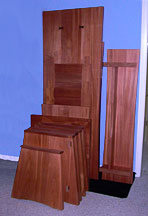
Most
of my furniture is designed to break down into manageable
parts. One strong person can move and assemble anything
I design. This makes it possible for me to ship a piece
to any place on the planet.
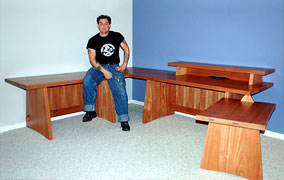
In the end, I’ve never had a client unhappy with the final result.
|

|
|
|